








![[New Size] ReSanskrit® 365 Days of Sanskrit Wisdom | Daily Sanskrit Quotes | With 100+ New Quotes, Hindi & English Translations🆕](http://resanskrit.com/cdn/shop/files/Main-bigger-size-resanskrit-365-calendar_533x.jpg?v=1773913199)
![[New Size] ReSanskrit® 365 Days of Sanskrit Wisdom | Daily Sanskrit Quotes | With 100+ New Quotes, Hindi & English Translations🆕](http://resanskrit.com/cdn/shop/files/Quote-shot-both-calendars-1_533x.jpg?v=1773913199)



10 Habits for great health in Sanskrit according to Ayurveda!

What is Ayurveda really?
For most of us, Ayurveda is just another way of treating illnesses with medicines that are made up of herbs. Well, Ayurveda is much much more than that and today, on National Ayurveda Day, we are going to explore that.
Ayurveda is the Upaveda (sub or near to veda) of Atharva veda. It’s also called Panchama veda (5th veda). The word Ayurveda is made of two words Ayu and Veda. The word Ayu doesn’t mean just life, instead it means –
शरीरेन्द्रिय सत्वात्मा संयोगो। – चरक संहिता १।४२
śarīrendriya
satvātmā saṃyogo।1.42
The union
of Shareera (body), Indriya (sense
organs), Satva (mind) and Atma (soul).
and Veda means knowledge. Hence, Ayurveda means the knowledge of the union of body, sense organs, mind and soul. So when people bless saying ‘दीर्घायुषी भव।’ (dīrghāyuṣī bhava।) it means let you be in union with all the above factors for a long time!
Long time ago, our sages took a note of the fact that people are becoming greedy, getting diseases and are not happy compared to what they were in the past. Some sages went in search of a remedy to cure diseases, make people remain healthy and happy. When they went to lord Indra, he preached the knowledge of Ayurveda to the sages, who then preached the same to their students and so on so forth. From there on the saga of Ayurveda started, for the sole purpose of betterment of mankind.

Principles that govern Ayurveda
svasthasya svāsthya rakṣaṇaṃ, āturasya vikāra praśamanaṃ। (Caraka Saṃhita Sūtra 30।26)
Ayurveda Shastra aims at keeping a healthy person healthy and managing or curing diseases (mind, body or both) that manifest in a person.
Ayurveda is based on mainly three principles –
Principle 1: Samanya Vishesha Siddhantha (Ordinary – Special Principle)
Ex: when you have dryness of skin, you might apply moisturizer to bring back the moisture that was lost in your skin. The moisture content of your skin is increased by a similar moisture containing the product. This is Samanya. At the same time, the dryness was reduced due to the Vishesha of moisture that is opposite to dryness in your skin.
For a drug to act, both Samanya and Vishesha principles come into play.
समान्यं एकत्वकरं,विशेषस्तु प्रुथक्त्व क्रुत् ॥
सर्वदा सर्व भावानां सामान्यं व्रुद्धि कारणं, ह्रास
हेतुर्विशेषस्च॥ (चरक संहिता सूत्र १।४५)
samānyaṃ
ekatvakaraṃ,viśeṣastu pruthaktva krut ॥
sarvadā sarva bhāvānāṃ sāmānyaṃ
vruddhi kāraṇaṃ, hrāsa heturviśeṣasca॥ (caraka saṃhitā sūtra
1।45)
The
principle of a dravya (substance) that brings about union or increase in the
dravya’s quality or
quantity is called as samanya. The principle of a dravya
that brings about non-union or decrease in a
dravya’s quality or quantity is
called as vishesha.
Principle 2: Panch Mahabhoota Siddhantha (5 Fundamental elements Principle)
Dravya is any substance that has qualities and actions residing in it. We, human beings are also a dravya. Ayurveda being more practical oriented subjective science, opines that based on the different structural and functional aspects of the universe and organisms, each and every cell, organ, organ systems and in general every Dravya (substance) in the universe is made of Pancha Mahabhoota (5 proto elements or atoms) that are in different proportion in each substance –
- Prithvi (earth proto element)
- Aap (water proto element)
- Agni (fire proto element)
- Vaayu (air proto element)
- Akasha (space proto element)
For example, the hardness of bones is due to Prithvi Mahabhoota predominance. The unctuousness in our body, all fluids is due to Aap Mahabhoota predominance. The temperature of one’s body, various digestive fluids is due to Agni Mahabhoota predominance. Various movements of enzymes to target cells, bodily movements are due to Vaayu Mahabhoota predominance. The hollowness of different organs like lungs, heart, etc is due to Akasha Mahabhoota predominance.
Principle 3: Tridosha Siddhantha (Tri-defect Principle)
The 5 Mahabhoota’s combined with each other give rise to 3 Dosha’s (type of defects) that help in maintaining physiology of our body when in stable state and they cause diseases when in unstable state. These are like the basic software of our body.
वात (Vaata) – The dosha that is responsible for the movement of each and every atom, and also provides space for all movements to occur. For example, the act of respiration, peristaltic movements in the intestine, excretion of waste from our body, movement of nerve impulses in the nerves, initiation to do any work, etc.
पित्त (Pitta) – Responsible for any transformation taking place in our body and also the temperature changes in our body. For example, digestion, metabolism, breaking of large food particles to smaller ones for absorption in our body, etc.
कफ (Kapha) – Responsible for energy storage, the formation of new structures, protection in our body and bonding between molecules in our body to form larger molecules. For example, immunity, synovial fluid in joints, mucous lining protecting the digestive tract, adipose tissue storing fat, the stability of our body and mind, etc.
Top 10 – Ayurveda Recommended habits for being healthy
Based on above principles, here are some of the most effective health tips mentioned in Ayurveda for those who aspire to be healthy-as-a-horse individuals and to remain the same!
Habit 1: Wake up in ब्राह्मि मुहूर्त (brāhmi muhūrta)
A healthy individual should wake up approximately 96 minutes before sunrise to stay healthy. Brahma means knowledge. The time to seek knowledge is called as Brāhmi Muhūrta.
Reason: We humans have an internal clock that maintains a cycle of events at a 24 hour interval. It is found that the body temperature is minimum at 5:00 AM, the sleep inducing hormone Melatonin is at its minimum level at the day time and also the hormone Cortisol that helps to withstand stress and traumas in life is secreted more at this time.
Moreover, the level of nascent oxygen is 40% in the environment at this time, so the more one is awake at this time, the more oxygen one gets and the more healthy all the tissues function in one’s body, as our bodily functions require oxygen for every process. waking up at this time keeps one’s body in sync with environment and our bodily changes too. Hence, do wake up in Brāhmi Muhūrta.

Habit 2: Do exercise (व्यायाम) everyday!
शरीरायास जनकं कर्म व्यायाम उच्यते (commentary by Arunadatta on अष्टांग संग्रह संहिता सुत्र २।१४) – any action that makes one tired is termed व्यायाम (vyāyāma).
अर्धशक्त्या निषेव्यस्तु बलिभि: स्निग्धभोजिभि:।
शीतकाले वसन्ते च मन्दमेव ततो अन्यदा।। (अष्टांग ह्रदय संहिता सुत्र २।११)
Transliteration:
ardhaśaktyā niṣevyastu balibhi: snigdhabhojibhi:।
śītakāle vasante ca mandameva tato anyadā।।
English Translation:
One who is strong and eat unctuous food everyday should use half of one’s energy to do व्यायाम.
Same to be done in winter season and autumn. In summer and rainy season, one should use less
than half energy to do व्यायाम .
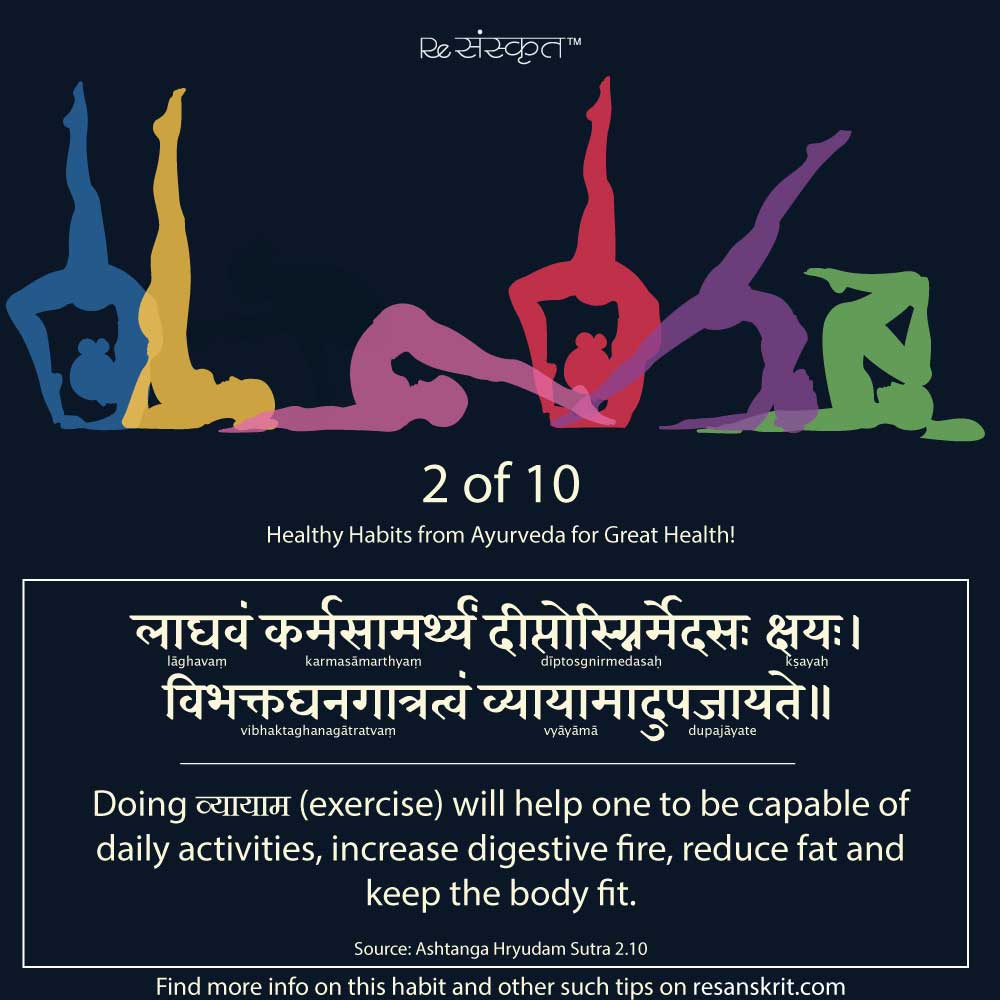
Reason:In Ayurveda, doing व्यायाम is said to reduce Kapha Dosha and Medha Dhatu, which is the main cause of the disease प्रमेह (diabetes mellitus and related diseases), रक्तचाप (Atherosclerosis, hypertension and related diseases), etc.
However, It is not recommended for elderly (above 70 years), young (below 16 yrs) and those having वात(vaata) and पित्त(pitta) diseases.
Since, in old age (above 70), most of one’s Dhatus (tissue systems) keep depleting, hence doing व्यायाम further depletes the Dhatus which are already in that stage due to age related changes. In young age (below 5), not all Dhatus are completely formed or matured, hence doing व्यायाम will deplete dhatus that are yet to gain their full potential.
Research: It is found by observational research that, those who are physically active exhibited a 30-40% reduction in relative risk of colon cancer and 20-30% women showed reduction in the relative risk of breast cancer.

Bring Sanskrit home!
Buy ReSanskrit Merchandise...
Browse Collection!
Habit 3: Do अभ्यंग (Abhyanga-oil application) everyday!
अभ्यंग means applying oil in अनुलोम गति (direction of our hair) all over the body. Doing Abhyanga every day will reduce premature aging or keep one young, reduce tiredness, pacifies Vaata Dosha, brings clarity to the eyes, nourishes the body, facilitates sound sleep and makes one’s skin healthy.
It’s good to apply oil to the whole body, but if it is not possible, one should apply it to face, scalp, into the ears and feet.
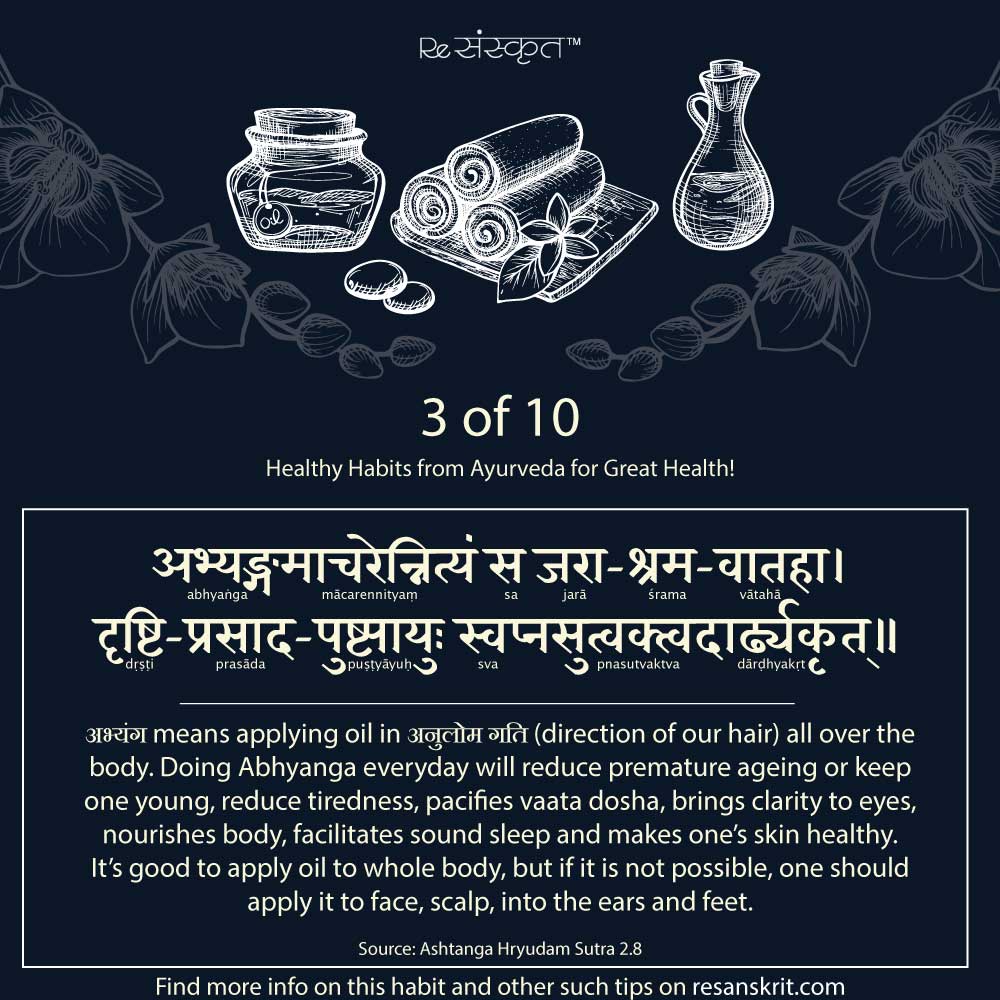
CAUTION: Take care as to remove the oil in the ears with a cotton wick after counting to 100 times the number 1. One should not apply pressure while applying warm oil; just spread oil in the direction of body hair in swift motions for at least 15 minutes.
What
is the
Time to
do and
which
oil to
use?
It’s
best done
with coconut
oil or
sesame oil
before bath
in the
morning
after
exercise.
After
अभ्यंग
procedure?
Take
warm water
bath.
Research: In a pilot study it was found that Abhyanga statistically reduced subjective stress, BP and heart rate in pre-hypertensive subjects.
A study was conducted on basketball players to elicit the effect of Abhyanga on muscle strength, it was found that Abhyanga increased muscle strength significantly. However, with no Abhyanga for a 15 days led to the reduced muscle strength. This shows how important it is to do Abhyanga everyday and especially after exercise.
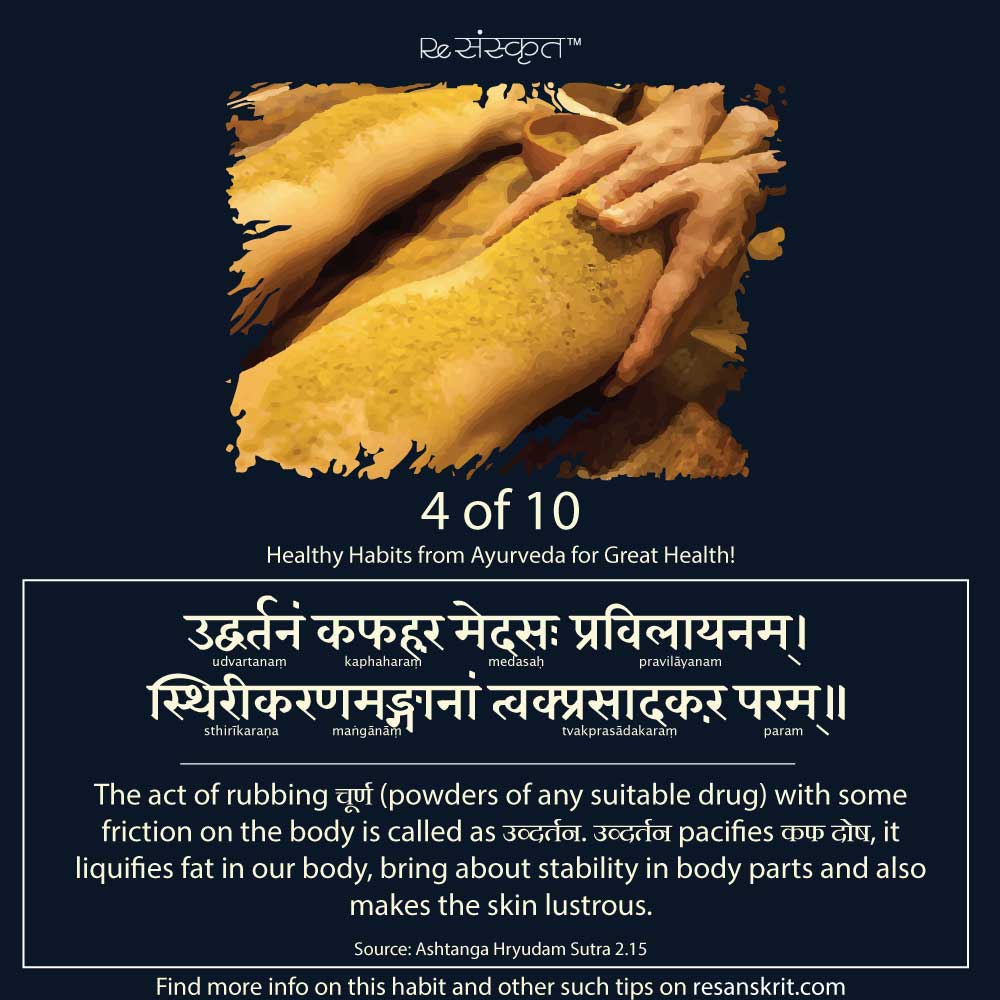
Habit 4: Do उव्दर्तन (Uvdartana – scrubbing using medicated powders) everyday!
उव्दर्तनं
कषायादि
चूर्णैर्गात्रोध्दर्षणं
(हेमाद्रि commentary
on अष्टांग
ह्रुदय
संहिता
सुत्र
२।१५)
uvdartanaṃ
kaṣāyādi
cūrṇairgātrodhdarṣaṇaṃ
The
act
of
rubbing
चूर्ण
(powders
of
any
suitable
drug)
with
some
friction
on
the
body
is
called
as
उव्दर्तन.
Which
powder
is
used
generally?
Turmeric,
Triphala (the
powder
of
dried
fruits
of
three
drugs),
gram
flour
are
combined
in
equal
quantity
in
powder
form
and
applied
as
a
bathing
powder
after
abhyanga
and
before
bath.
Research: A research conducted on healthy volunteers on the effect of udvartana showed that it significantly reduced body weight,body mass index, waist circumference,skin fold thickness, enhanced skin texture and also reduced stress.
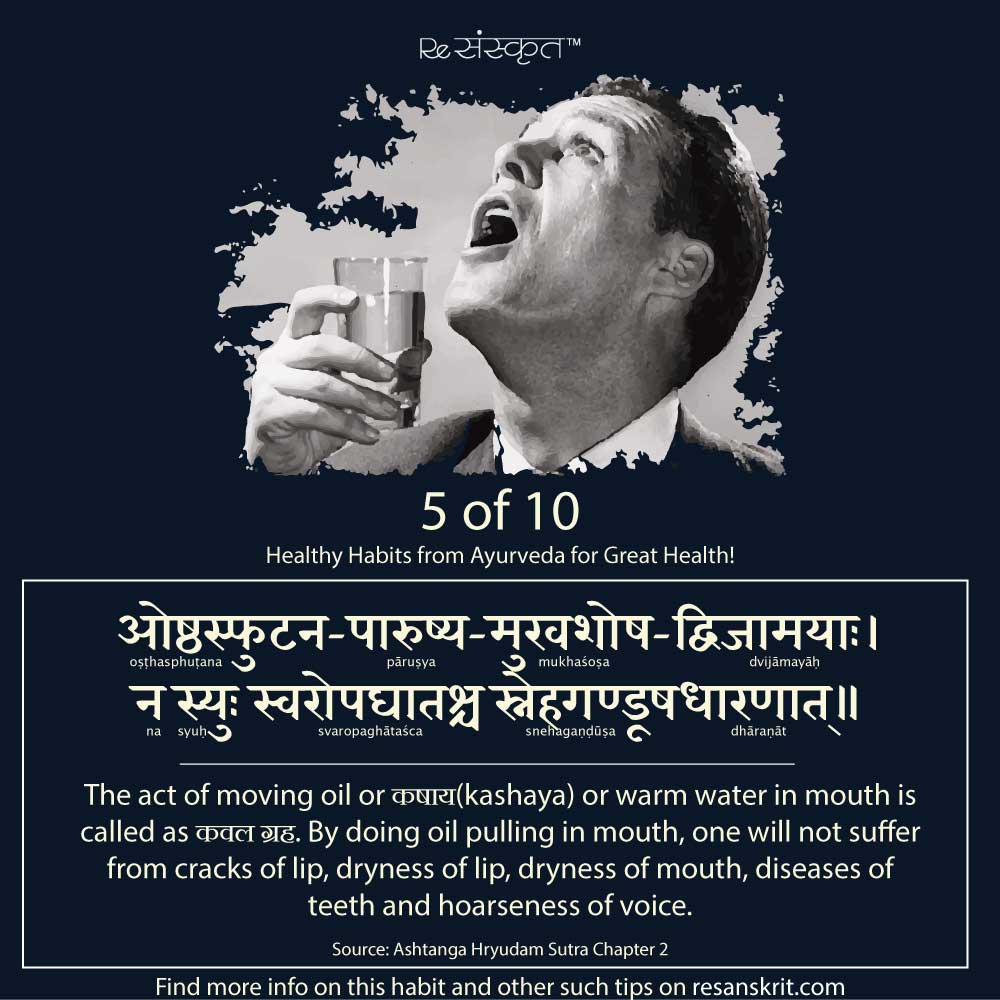
Habit 5: Do कवल ग्रह (Kavala Graha – oil pulling or hot water or kashaya gargling) everyday!
Which
Oil
to
be
used?
Sesame
oil
or
Coconut
oil.
Procedure:
Take
a
spoon
of
warm
oil
in
mouth
and
move
it
in
mouth
till
there
is
uncontrollable
or
excessive
salivation,thin
watery
discharges
from
eyes
and
nose.
Research:
A study done
to
know
the
effects
of
oil
pulling
on
oral
health
showed
significant
reduction
in
plaques
and
modified
gingival
index.Also
there
was
considerable
reduction
in
microbial
colony
count
in
mouth.
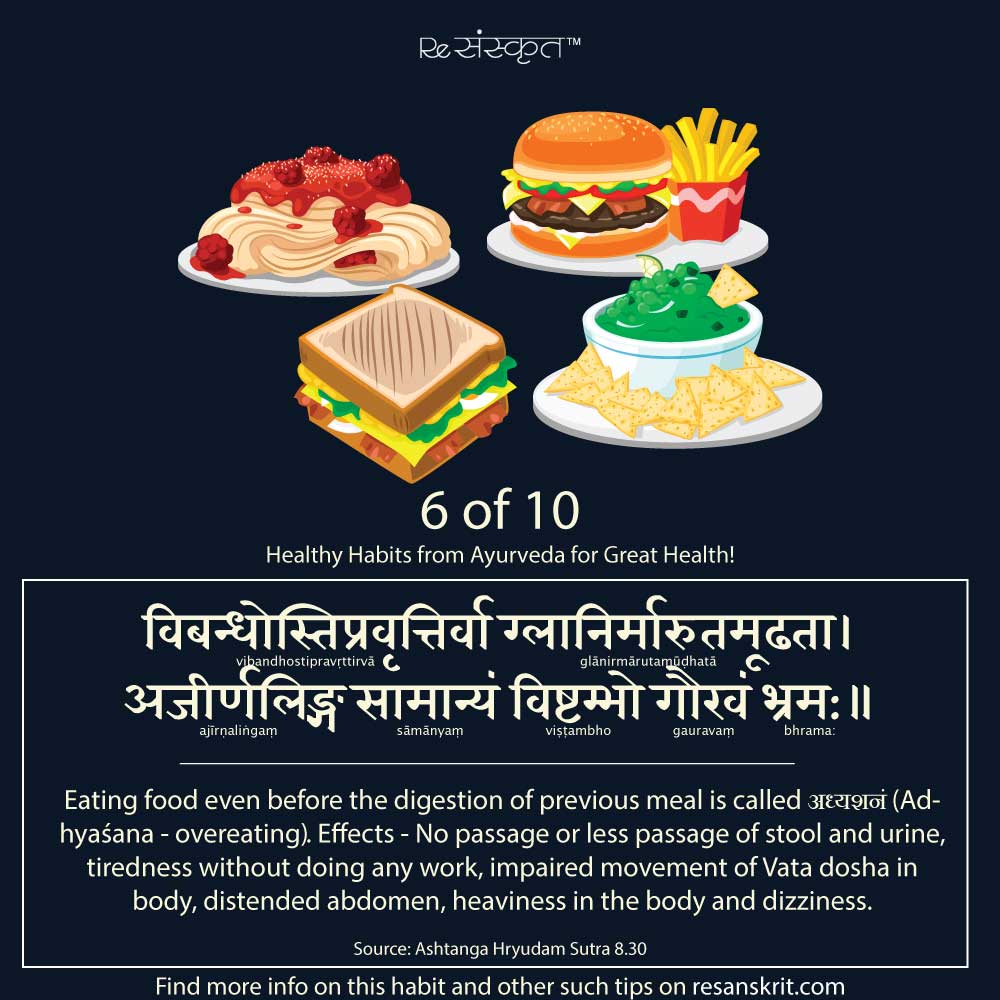
Habit 6: Stop अध्यशन (Adhyaśana – overeating)
अध्यशनं
भूयो
भुक्तस्योपरि
भोजनं
(अष्टांग
ह्रुदय
संहिता
सुत्र
८।३४ )
adhyaśanaṃ
bhūyo
bhuktasyopari
bhojanaṃ।
Eating
food
even
before
the
digestion
of
previous
meal
is
called
अध्यशनं.
Reason: When
you
overeat,
stomach
expands
to
contain
the
food
and
hence
puts
pressure
on
other
organs
making
you
feel
fullness,
distended
abdomen,
sluggish
or
tired.
Stomach
produces
hydrochloric
acid
to
breakdown
food,
which
is
thrown
back
to
food
pipe
causing
heartburn,
our
body
tries
to
metabolise
extra
calories
leading
to
feeling
temporarily
hot
or
even
dizzy.
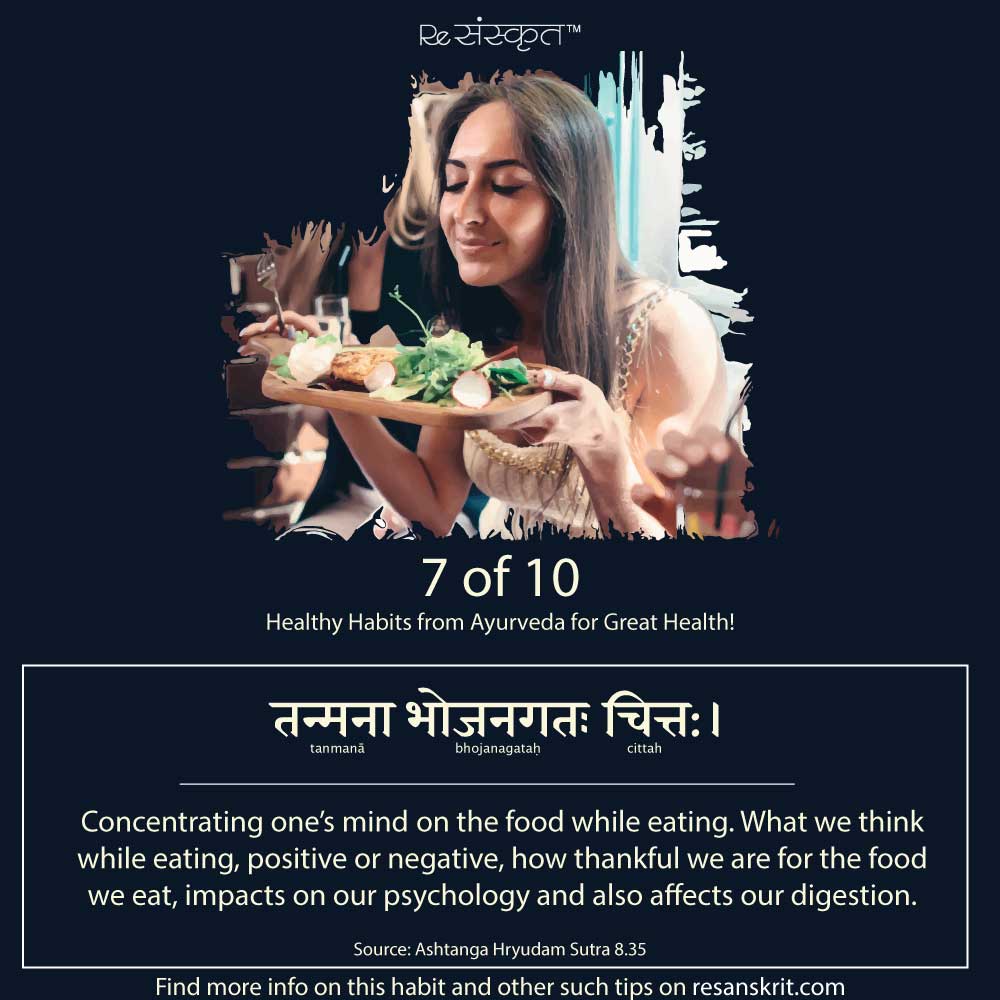
Habit 7: Eat with तन्मना (tanmanā – mindfulnes)!
Reason:
What
we
think
while
eating,
positive
or
negative,
how
thankful
we
are
for
the
food
we
eat
impacts
on
our
psychology
and
also
affects
our
digestion.
The
first
phase
or
step
of
digestion,
the
cephalic
phase
(begins
when
we
see,
smell
and
think
about
food)
only
works
when
we
are
relaxed
and
paying
attention
to
what
we
eat.
On
the
other
hand,
stress
shuts
down
digestion.
Research:
A study conducted
on
treatment
of
obesity
and
overweight
individuals
with
mindful
eating
as
complementary
treatment.
It
was
found
to
help
in
treating
both
of
the
above
conditions
than
just
with
the
help
of
medicines.
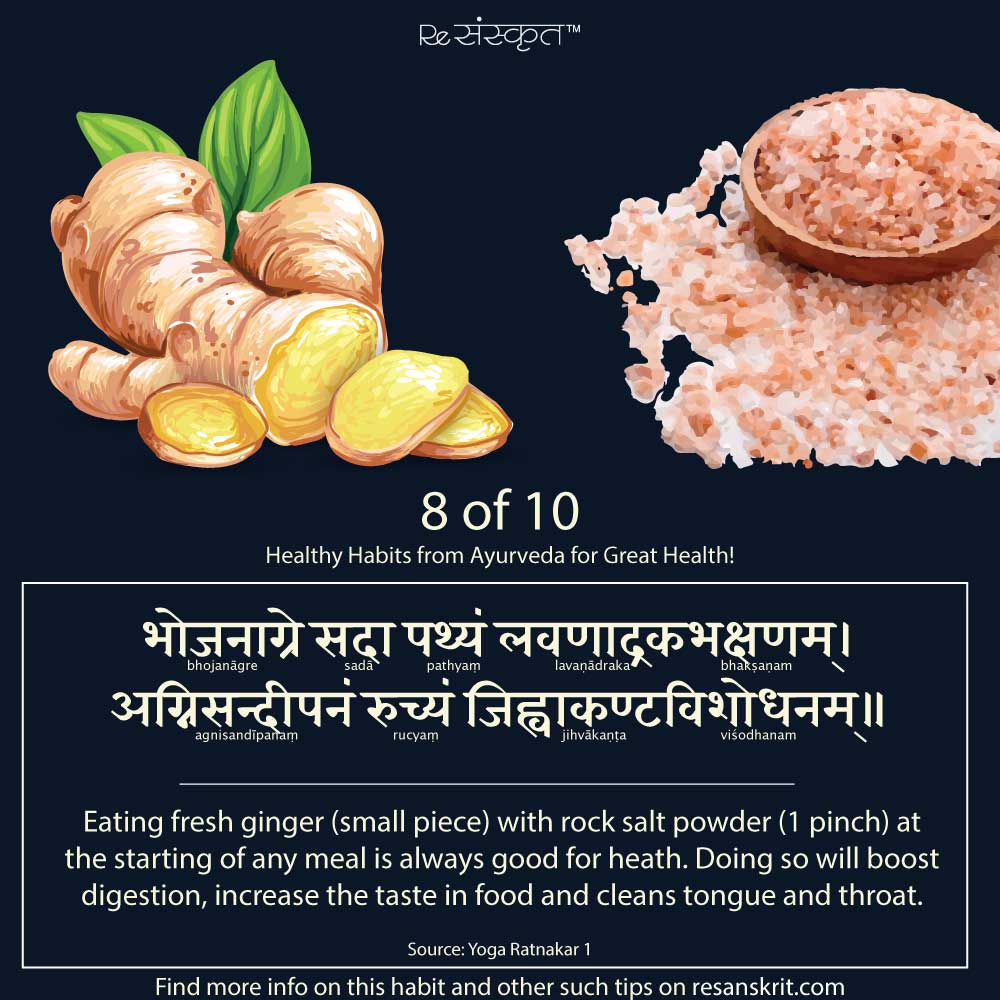
Habit 8: Eat शुण्टि (fresh ginger) with सैन्दव लवण (Rock salt) before any meal!
Research:
Ginger is
found
to
act
as
antioxidant,anti-inflammatory,anti
nausea
compound,
and
anticancer
agent. Rock
salt is
also
a
good
antioxidant,
maintains
blood
pressure
and
also
used
to
reduce
to
reduce
cough,cold,etc.
Habit 9: Drink उष्णोदक (Uṣṇodaka-boiled water), but according to the need:
उष्णं
क्वथनोष्णं
(हेमाद्रि
commentary
on
अष्टांग
ह्रुदय
संहिता
सुत्र
५।१६)
uṣṇaṃ
kvathanoṣṇaṃ
Water
that
is
boiled
and
reduced
to
1/4th
or
1/3
rd
or
1/2
is
called
as
उष्णोदक,
which
is
unlikely
of
what
the
modern
water
purifiers
do.
The
same
can
become
harmful
if
used
in
following
conditions:
Alcoholism,
fainting,
vomiting,
tiredness,
confusion,
thirst,
burning
sensation
in
the
body,
poisoning,
Pitta
Dosha
caused
diseases
and
blood
related
conditions.
Research:
Studies have
found
that
drinking
hot
water
increased
metabolism
by
30%
which
lasted
for
30-40
minutes
after
consumption.it
also
facilitated
weight
loss,increased
digestion
and
reduced
constipation.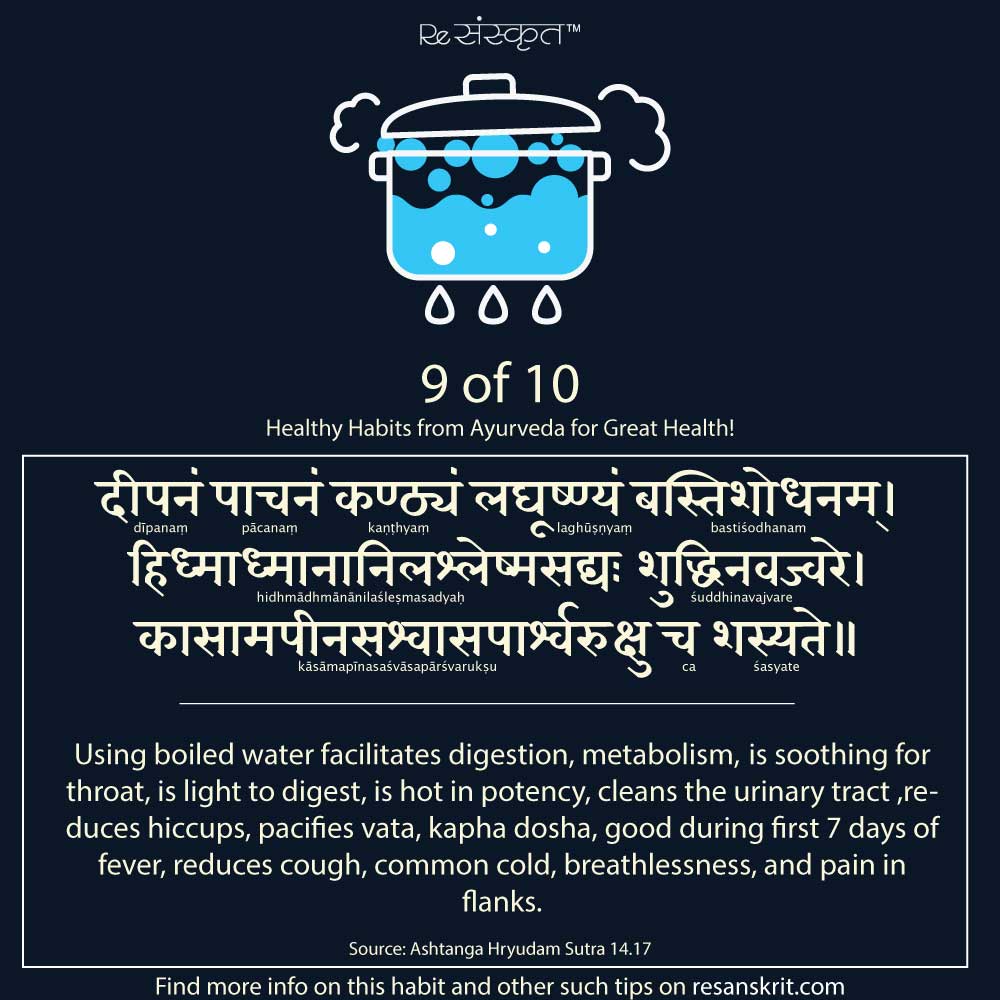

Notebooks
with
Sanskrit
quote
on
each
page!
Buy
ReSanskrit
Merchandise...
Browse
Collection!
Habit 10: Do लंघन (Laṃghana- calorie restriction – fasting) once a week!
यल्लाघवाय
कार्श्याय
तल्लंघनं।
(हेमाद्रि
commentary
on
अष्टांग
ह्रुदय
संहिता
सुत्र
१४।२)
yallāghavāya
kārśyāya
tallaṃghanaṃ।
That
which
brings
about
lightness
in
the
body
or
that
which
makes
one
lean
is
called
as
लंघन.
Fasting is one among 10 types of लंघन.
Which
is
the
ideal
time?
Skipping
dinner
once
a
week
is
ideal
for
all
body
types.
Research:
Studies conducted
in
overweight
humans
show
that
calorie
restriction
or
fasting
improves
health
outcomes
including
several
cardiac
risk
factors
(which
might
cause
heart
diseases),
improving
insulin
(factor
responsible
for
glucose
metabolism)
sensitivity
and
oxidative
damage
to
both
DNA
and
RNA
hence
help
in
healthy
aging.

Bonus Habit: Healthy Drink Tips!
भोजनान्ते
पिबेत्तक्रं
वासरान्ते
पिबेत्पयः
।
निशान्ते
च
पिबेद्वारि
त्रिभिर्रोगो
न
जायते
॥
bhojanānte
pibettakraṃ
vāsarānte
pibetpayaḥ
।
niśānte
ca
pibedvāri
tribhirrogo
na
jāyate
॥
भोजन
के
अन्त
में
मट्ठे
का,
दिन
के
अन्त
में
दूध
का,
और
रात
के
अन्त
में
(अर्थात्
सुबह)
पानी
का
सेवन
करने
से
रोग
उत्पन्न
नही
होता।
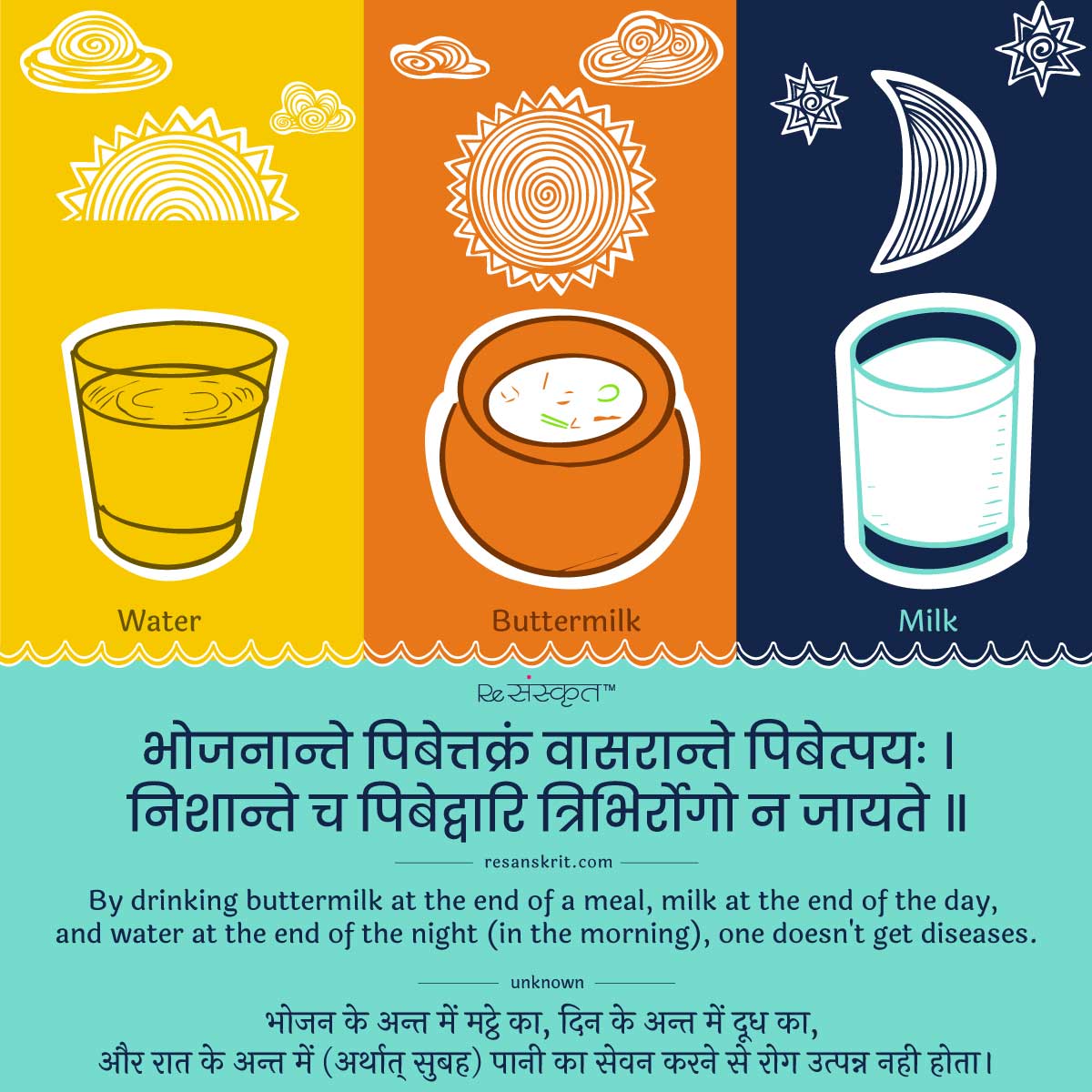
By drinking buttermilk at the end of a meal, milk at the end of the day, and water at the end of the night (in the morning), one doesn’t get diseases.
We can see that most of the tips told above are mainly concentrating on remaining healthy, fit, boost immunity, prevent premature aging (a major issue in present generation) and also improve digestion so that essential nutrients enter our body.
Hence remaining healthy is given more importance in Ayurveda and then the second priority is given for managing diseases, for the sole purpose of achieving 4 major goals of one’s life which are
धर्म-अर्थ-काम-मोक्षाणां
आरोग्यं
मूलं
उत्तमं।
(चरक
संहिता
सुत्र
१।२४)
dharma-artha-kāma-mokṣāṇāṃ
ārogyaṃ
mūlaṃ
uttamaṃ।
Dharma-Those
duties
or
actions
that
give
us
support
Artha-
material
wealth
Kama-our
wishes
Moksha-
Free
from
all
attachments.
All
the
4
root
cause
of
which
is
health.
Bonus Quotes: Sanskrit Quote on Monsoon Diet in Ayurveda
Ayurvedic Monsoon Diet from Charaka Saṃhitā
Varṣā Ṛtu (Monsoon)

पिबेत् क्षौद्रान्वितञ्चाल्पं माध्वीकारिष्टमम्बु वा।
माहेन्द्रं तप्तशीतं वा कौपं सारसमेव वा॥
pibet kṣaudrānvitañcālpaṃ mādhvīkāriṣṭamambu vā।
māhendraṃ taptaśītaṃ vā kaupaṃ sārasameva vā॥
The ideal liquid diet for the monsoon is a small quantity of Mādhvīkāriṣṭa mixed with honey,
along with pure rainwater, cooled boiled water, or water from a well or lake.
वर्षा ऋतु के लिए आदर्श तरल आहार है - अल्प मात्रा में मधु के साथ मिश्रित माध्वीकारिष्ट का पान करना चाहिए;
तथा शुद्ध वर्षाजल, उबालकर ठंडा किया हुआ जल, अथवा कुएँ या झील का जल।
Source - carakasaṃhitā 1.6.38
Caraka Saṃhitā 1.6.36

व्यक्ताम्ललवणस्नेहं वातवर्षाकुलेऽहनि।
विशेषशीते भोक्तव्यं वर्षास्वनिलशान्तये॥
vyaktāmlalavaṇasnehaṃ vātavarṣākule'hani।
viśeṣaśīte bhoktavyaṃ varṣāsvanilaśāntaye॥
On cold, rainy, and windy days, eat warm food that is slightly sour, well-salted, and rich in healthy fats to help balance Vāta.
ठंड, वर्षा और तेज़ हवा वाले दिनों में वात को संतुलित रखने के लिए थोड़ा खट्टा, पर्याप्त नमकयुक्त और स्निग्ध (घीयुक्त/तेलयुक्त) भोजन करें।
Source - caraka saṃhitā 1.6.36
We hope you liked out composition of top 10 habits that will make your life more healthy. Please let us know your thoughts and feedback in the comments below. We would love to know which topics you’d want us to cover next.
Read our take on Aditya Hrudayam Stotram.
Like our work? Follow us on Instagram!

Team ReSanskrit
Scholars, Designers & Sanskrit Enthusiasts
ReSanskrit is a passionate team of Sanskrit scholars, designers, and cultural enthusiasts united by one mission - making the timeless wisdom of Sanskrit accessible to the modern world. Every article we publish is researched, crafted, and reviewed collectively to bring you content that is both authentic and engaging.
Write for ReSanskrit


13 Comments
Excellent tips on health based on Ayurvedik Science.
Excellent work done… U r truly spreading ayurveda knowledge to common people which is very imp…. Base knowledge..we can discuss n there are yet many sutras…. Which can me shared more…. As like उष्णं अश्नियात etc
I like this information. I need Health Related Quotations who right by our rushimuni with his name. Pls help.
Beautiful
Genuinely appreciate your incredible work.